AdvaMed’s Digital Health Tech division brings together leading companies developing AI-enabled solutions that are transforming health care, from diagnosis and treatment to clinical decision support and care beyond traditional settings.
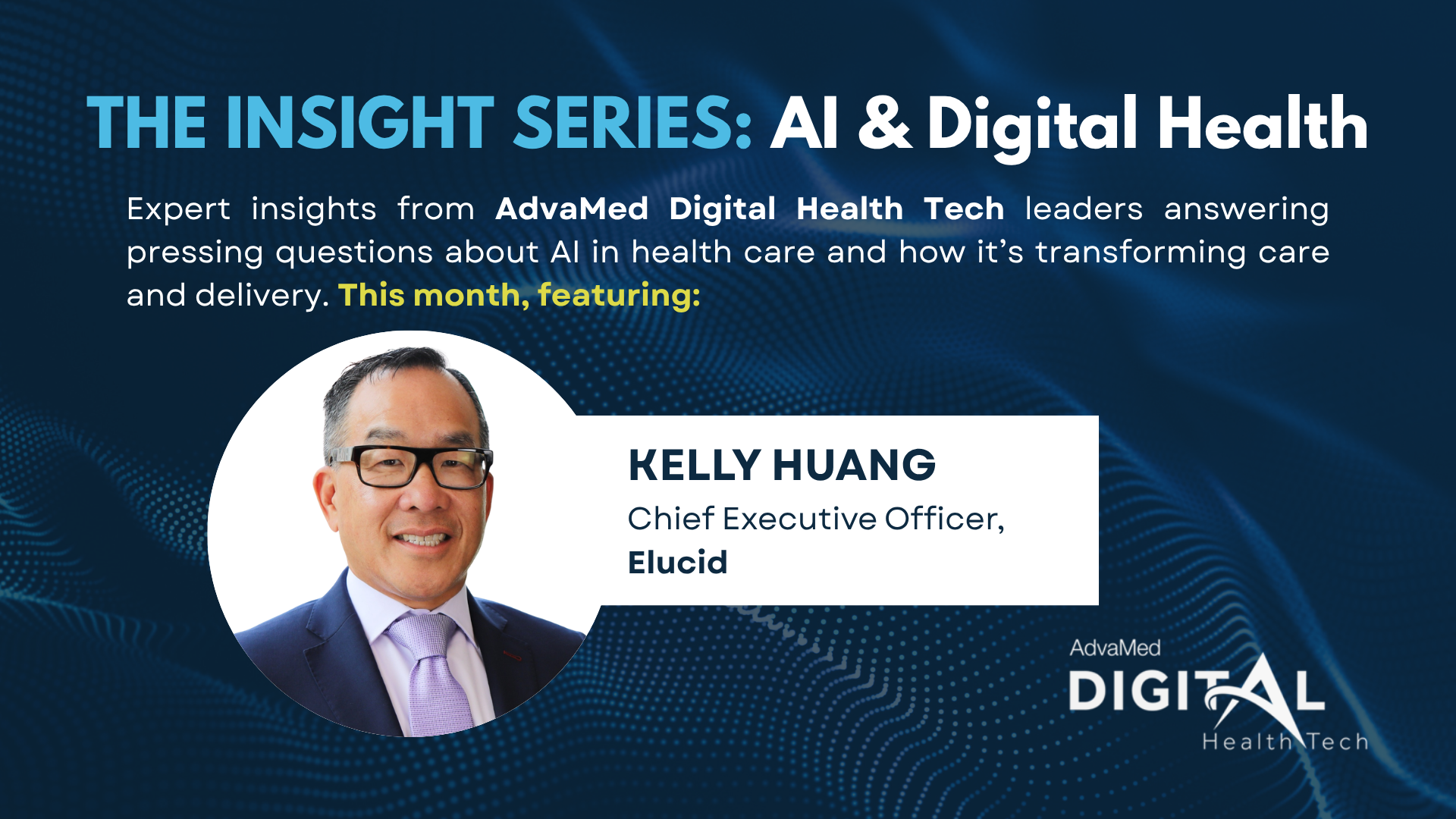
“The Insight Series: AI & Digital Health” features industry experts answering key questions to help inform policymakers and the public about how AI is shaping the future of care delivery. This edition features Kelly Huang, CEO of Elucid, an AI medical technology company focused on providing physicians with a more precise, non-invasive view of atherosclerosis to drive patient-specific cardiovascular care.
AdvaMed: What are the biggest benefits AI brings to patient care today, and what’s just hype?
Kelly Huang: The biggest benefit is turning imaging we’re already collecting into information that physicians could never see before. At Elucid, a patient’s existing coronary CT angiogram can also be analyzed with our Plaque-IQ software to quantify the type and amount of plaque in both coronary and carotid vessels, and, with our BioIntegrated FFR-CT* (CT-derived Fractional Flow Reserve, or the derived pressure and blood flow drop across a narrowed section (stenosis) of a coronary artery) to help physicians understand the overall risk of the patient for heart attack and stroke based on detailed lesion-by-lesion information. Traditionally, plaque type at highest risk for rupture and FFR would be tedious to measure by invasive imaging and pressure wire catheterizations. With Elucid, both of those factors, which the human eye simply cannot extract from a scan, can be quantified from a single, non-invasive test. We see this play out in our own data: two patients can look identical on paper — same total plaque volume and similar degree of stenosis — turn out to have very different disease and overall risk once you look at the biology, because one patient’s plaque is lipid-rich and unstable, and the other’s is calcified and stable. Same data, different disease … understanding the disease through integration of anatomy, biology, and physiology can now lead to more personalized treatment. It is not just about risk calculation; it is turning that risk information into personalized therapy. That’s exactly the kind of progress AI should be leading.
When AI is a black-box that doesn’t change what a physician does next – this is when the result is not pragmatic nor transparent and inspectable by the physician. This becomes the “hype.” We built our platform so physicians can always see the work behind every step (the underlying vessel and lumen segmentation, the plaque composition, the FFR-CT based on integration of all biological and anatomical properties of plaques and vessels, the FFR-CT pullback curve, and the lesion tool) rather than trusting an output they cannot verify. If an AI output doesn’t lead to a different, better-informed clinical decision, it’s a novelty, not a benefit to patient care. Moreover, Elucid always supports the physician in making care decisions. We believe the future of AI replacing doctors is hype. We aim to support better clinical decision making by physicians and closing the gap between need for care and the ability to provide care.
AdvaMed: Your primary focus is cardiovascular diagnostics. How is artificial intelligence changing the way we diagnose serious heart conditions?
Kelly Huang: For years, coronary CT angiography (CCTA) answered one question: is there a blockage, and how severe is it? We think of that period in cardiovascular care as CCTA 1.0, anatomy alone: stenosis, plaque volume, vessel remodeling. The field then moved to what I’d call CCTA 2.0, adding AI-derived plaque or FFR-CT estimates, but largely as separate tools used at different stages of disease. We believe we’re headed toward CCTA 3.0: where anatomy, biology, and physiology are integrated together, at a lesion-by-lesion level, from a single noninvasive scan to enable truly personalized treatment decisions.
The concept of a “serious heart condition” is often oversimplified. In reality, heart disease exists along a broad clinical spectrum, beginning with asymptomatic early atherosclerosis and potentially progressing to a devastating myocardial infarction. Elucid’s platform is designed to support physicians across every stage of this continuum: from primary care physicians and preventive cardiologists to cardiovascular imaging specialists and interventional cardiologists.
By enabling a more thorough and informed assessment of each patient’s disease, Elucid can help clinicians deliver more personalized and comprehensive care. This may include optimizing medical therapy, providing reassurance when appropriate, planning targeted local interventions, or confidently deferring unnecessary procedures. Our Plaque-IQ software applies algorithms trained and validated against ground-truth histology, the gold standard for plaque analysis, so physicians can see the composition of the plaque biology: how much is calcified and stable versus lipid-rich and vulnerable to rupture. Our BioIntegrated FFR-CT* uses invasive FFR as ground truth and integrates anatomy and plaque biology, which can dramatically impact vasodilatory capacity, to predict the FFR values along each vessel. Because anatomy, biology, and physiology come from one internally consistent model of the same artery, our plaque analysis and FFR-CT are always concordant, instead of being estimated separately and reconciled after the fact. It lets physicians non-invasively diagnose disease biology and its functional consequences, not just anatomy.
AdvaMed: When we talk about AI creating efficiency in healthcare, we’re often talking about doing the same things faster. Why do you believe that faster wasn’t the point — and what does it actually take to build AI that changes what happens to a patient, not just how quickly it happens?
Kelly Huang: The main issue is that for the past many years, cardiovascular disease is the number one killer in the developed and the developing world. On the one hand, this highlights the importance of cardiovascular medicine as a field; on the other hand, it shows that we need better pathways, better assessments, and possibly more personalized assessments and solutions. Speed doesn’t help if the underlying decision is still built on the same incomplete information. Reading those same data faster wouldn’t have told either physician what they needed to know, and nearly half of all heart attacks happen in patients who were classified as low risk using traditional factors like age, cholesterol, and family history.
Building AI that changes outcomes means building it to surface something clinically new and actionable: information that wasn’t visible to the physician before, validated rigorously enough that they can trust it and act differently because of it. However, it is important to mention that alongside our focus on equipping physicians with tools and data that can improve patient outcomes and reduce cardiovascular events, we remain equally committed to workflow efficiency. Elucid’s platform is designed to reduce the burden on clinicians by automating repetitive tasks, streamlining workflow, and allowing physicians to spend more time on meaningful patient interaction and care decisions.
AdvaMed: Health tech has largely delivered on its efficiency promise: documentation is faster, queues are shorter, operations are leaner. So why aren’t outcomes keeping pace, and what do you believe the causes are?
Kelly Huang: Efficiency and outcomes are different problems with different solutions. Most digital health tools have optimized the workflow around a clinical decision (how quickly a note gets written, how fast a patient moves through a visit) without changing the substance of the decision itself. If a physician is still stratifying cardiovascular risk using population-level factors, getting them to that same conclusion faster doesn’t prevent the heart attack that occurs in a patient that those factors miss. Improving outcomes requires giving physicians better information to act on, not just faster access to the information they already had. Ultimately, we can’t out-efficiency a diagnostic blind spot. Outcomes will only move when the underlying clinical picture gets more precise, not just faster to produce.
AdvaMed: Healthcare organizations face an overwhelming number of AI solutions. What criteria should health systems use to determine which technologies are most likely to improve patient outcomes and deliver lasting value?
Kelly Huang: I’d point health systems to three things. First, is the technology providing accurate information? What is it validated against? Is it compared to a real ground truth? Second, is the data that it provides reproducible? We have shown excellent reproducibility on all data that Elucid’s platform provides. Third, is there regulatory clearance and, ideally, peer-reviewed and real-world evidence showing the technology changes clinical management, not just that the algorithm performs well in isolation? Fourth, is there transparency? Can physicians see how the AI arrived at its answer? A tool that shows its work, down to the underlying segmentation and plaque composition, earns trust in a way black-box output never will, and that trust is often what determines whether a technology gets used at the point of care or quietly ignored.
AdvaMed: Many healthcare leaders feel they have an AI strategy in place. What blind spots do you see most often, and what risks do organizations face if they underestimate how quickly AI capabilities are evolving?
Kelly Huang: The most common blind spot is treating “AI strategy” as one thing, when in reality the maturity and evidence base behind different AI tools varies enormously; a scheduling algorithm and a diagnostic algorithm trained on histopathology are not in the same category of risk or opportunity and shouldn’t be governed the same way. In cardiovascular imaging specifically, I’d add a second blind spot: assuming anatomy-only tools, or even anatomy-plus-one-additional-layer tools, are the finish line. Oncology already went through this evolution over the past decade — from anatomy alone (how big a tumor is, how far it has spread) to layering in biology and physiology (what’s driving it, how active it is) to prognostic risk models that predict how a specific tumor will behave. Cardiology tools are only now catching up: we just enrolled our first patient in AI-PREDICT, an international study across more than 20 sites and roughly 1,000 subjects aimed at establishing exactly that kind of lesion-level risk paradigm for coronary disease. Organizations that lock into single-layer AI today risk having to re-platform once this becomes the standard. The third blind spot is a “set it and forget it” mindset; models get retrained and evidence bases mature quickly, so a tool adopted once and never revisited quietly falls behind.
AdvaMed: For years, healthcare has focused on treating disease once symptoms appear. How do you see AI accelerating the shift toward prediction, prevention, and earlier intervention?
Kelly Huang: You are absolutely correct. For historical reasons and because of previous technological limitations, the practice of cardiology has largely relied on symptoms and traditional risk factors as the primary gatekeepers for further evaluation. An asymptomatic individual classified as low- or borderline-risk by standard cardiovascular risk calculators (Pooled Cohort Equations or the PREVENT score) is often reassured without direct assessment of underlying coronary disease.
However, a recent peer-reviewed article in Journal of the American College of Cardiology: Advances demonstrated that a symptom and risk factor–based approach would have failed to identify nearly half of the patients who went on to experience a myocardial infarction within 48 hours of their assessment.
The field is ready for a new approach. The technological limitations that once prevented direct assessment of atherosclerosis no longer exist. Our strategy should now align with the known pathophysiology of myocardial infarction: the process begins with plaque formation, progresses through the accumulation and transformation of atherosclerotic plaque and inflammation, and ultimately culminates in plaque rupture or erosion for an acute coronary event.
At its core, myocardial infarction is a disease of plaque and atherosclerosis progression. We should therefore have a serious discussion about developing a cost-effective strategy for screening and early detection — moving beyond guesstimation toward the direct visualization and quantification of disease.
Validated algorithms now let us add the biology and physiology layers non-invasively, quantifying risk that is based on all components before a patient ever has symptoms. About half of Americans between 45 and 84 have atherosclerosis and most don’t know it. We believe that studies like AI-PREDICT can help accelerate the prognostic risk assessment and help determine which plaque features actually predict a future event, not just which arteries look narrow. That’s what will let physicians move from estimating a patient’s statistical risk to directly visualizing and forecasting their actual disease, which is what makes truly personalized prevention possible.
AdvaMed: Looking ahead ten years, how do you think the patient journey for cardiovascular disease will differ from what we see today?
Kelly Huang: Today, heart attack and stroke remain the #1 killer globally, yet WHO estimates 80% are preventable. Elucid believes AI will be a key technology to address this gap.
We expect symptoms and risk factors to be secondary to plaque presence for initiation of treatment for coronary artery disease. The combination of anatomy, biology, and physiology will identify highest risk lesions, and prognostic risk factors that will determine time for lesion stabilization by medication vs time for lesion rupture. In this future, traditional risk factors inform situs of treatment and together with plaque biology and physiology, physicians will be able to personalize optimal medical therapy. Should the time to rupture be faster than the time to medication stabilization, we believe revascularization will be warranted even if not flow restricting – a requirement for reimbursement of revascularizations today. Elucid is planning a series of randomized clinical trials to support better understanding of this approach to precision medicine in coronary artery disease management.
* FFR-CT and Stenosis are pending FDA review.
Hear Patient Stories
The Story of Medtech empowers patients to share their experiences with medical technology in an effort to educate, inspire, and create community.


